

Critical Critique
Learned Vol. 8, Issue 29
Advice you didn’t ask for is criticism. I don’t remember where exactly I heard that, or even if those were the exact words, but the meaning stuck. I can clearly remember instances where receiving someone’s genuine advice felt like a slap in the face. In fact, I can tell you the three categories it most often arrives in: weight loss, child raising, and adapting to live in a foreign country1. But every piece of that advice has gone right off this duck’s back like so much rain in Spain.
Buuuuuuttttt, I’m also guilty as hell. It’s true, though I am loathe to admit it. I, too, have given unasked for advice. It’s not as clear in my memory though because when I give advice, I’m being a nice guy and passing on the benefit of my hard won wisdom! And whether or not my experience is directly related or even a little relevant is not something I often stop to consider. Because, well, see the preceding one hundred and sixty-three words.
That said, I bring this up now because criticism and critique have gotten a bit conflated in the discourse and that’s a problem.
As you can surmise, both words come from the root word critic, which we’ll define here as both someone who judges something and as someone who has the expertise to carefully analyze a work of art. In other words, a critic, in the best sense, is not someone who is dismissing something or just being negative for negativity’s sake but rather someone who has studied, learned, and practiced enough to be able to look at something and tell us what does and does not work about it.
Which brings me back to criticism and critique and how disappointed I am in Merriam-Webster2 for conflating them to the point that they have listed the two words as synonyms. That said, they have a couple of very important, very relevant definitions for criticism/critique:
the act of criticizing usually unfavorably
seeking encouragement rather than criticism
and
the art of evaluating or analyzing works of art or literature
And, look, as you and I know, there are no true synonyms in English. You don’t get to have a million and some words without imbuing each and every one without a plethora of nuance and subtlety. So, even though criticism and critique have been conflated, we have a chance to pull them back apart and make them do separate jobs.
Let me give you an example:
A couple years ago, everyone decided to get in a lather over Critical Race Theory,3 choosing to read it as an indictment of the system as it stands rather than a clinical, analytical critique of the systemic racism that disadvantages so many people of color in our existing political, economic, and social structures.
In other words, a critical read on the problems in our culture and how to fix them should not be read as a criticism of those in the system, even though they weren’t asking for advice on how to fix it. Because, critically, no one was asking for advice because no one knew it was a problem. You see the circular problem, here, right? If unasked for advice is criticism, it’s hard to offer solutions to problems we can’t see.

Basically, this is what I’ve been trying to do with this volume of Learned. I’m trying to critique the institutions and thinking that have created modern academia without criticizing anyone for being a part of it. I mean, I’m not out here telling people to quit their jobs or burn down the schools, but I am saying that those schools might need to be modernized a bit. Hence, critique but not criticize.
So. In the end, if we surrender the word criticism to the pedantic and uninformed, we gift it to those who would judge and dismiss us, our works, and our experience summarily without the experience or permission to do so, we are left with critique as a way of analyzing our works and our systems humanely and without attacking the creators of said works and systems.
Or, to put it simply, burn the straw men and critique the fire, not the builders.
Stay curious,
Joel
And Now For Something Completely Different
In previous volumes of Learned I gave out book recommendations - things I was enjoying that all y’all wordy nerdy types might enjoy, too. Since the holidays are descending upon us faster than your friendly neighborhood locust swarm, I thought it might be a good time to dedicate a little space in this and the next few issues to some word-nerd books you might like.
So, with that in mind, here’s the first recommendation (and yes, this is an affiliate link. If you buy the book after clicking this link, I get a li’l kickback):
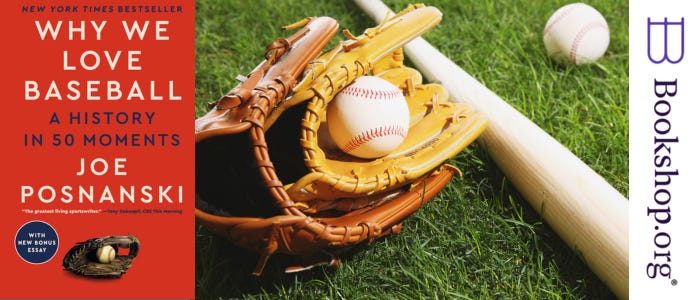
by Joe Posnanski
Hey, wait a minute, that’s not a word book! I know, but bear with me, I have a point to make: If you’re the kind of reader that gets into word nerdery because you love the weird histories and quirky stories that comprise the odd and erratic formation of our favorite words, then you’ll love this book. The author applies that same pedantic, laser-like focus the stories and moments that have built modern baseball.
By looking at the ways in which history cycles around in the form of incredible hits, bases, and outs, his work mirrors the etymologists’ love for how words come up again and again throughout history, slightly changed, but always simultaneously both familiar and new. Look, I’m not saying you’ll be a baseball stat nerd by the time you’re done with this book, but I am saying you’ll enjoy figuring out just why you could become one.
And Now For Something Completely Different, Part II
The Japan Writer’s Conference is happening in just a couple of weeks. I’m not sure if my schedule is going to allow me to attend both days (maybe not even one!) of the conference, but I’m going to try. If you’re in Japan and reading this and going to the conference, drop me a line and let me know what you’re going to be doing there. Maybe we can make some space for something interesting to happen.
Guess how much I advising I need or want from anyone about those three topics? If your answer is anything other than zero, go have a nice long sit down in the corner and think about your life.
I kid, I kid. Merriam-Webster could never disappoint me, they only allow me to be disappointed in myself when I cannot solve their fiendishly tricky word puzzle games.
Hold up - I have actually read the book. I’ve done a lot of reading about a lot of critical theories. In general, critical reading and critical analysis are good things. So before you go all flame on in my comments section, have your lit review prepped and your sources cited.